2024.09.03 | About Akoya Pearls Color
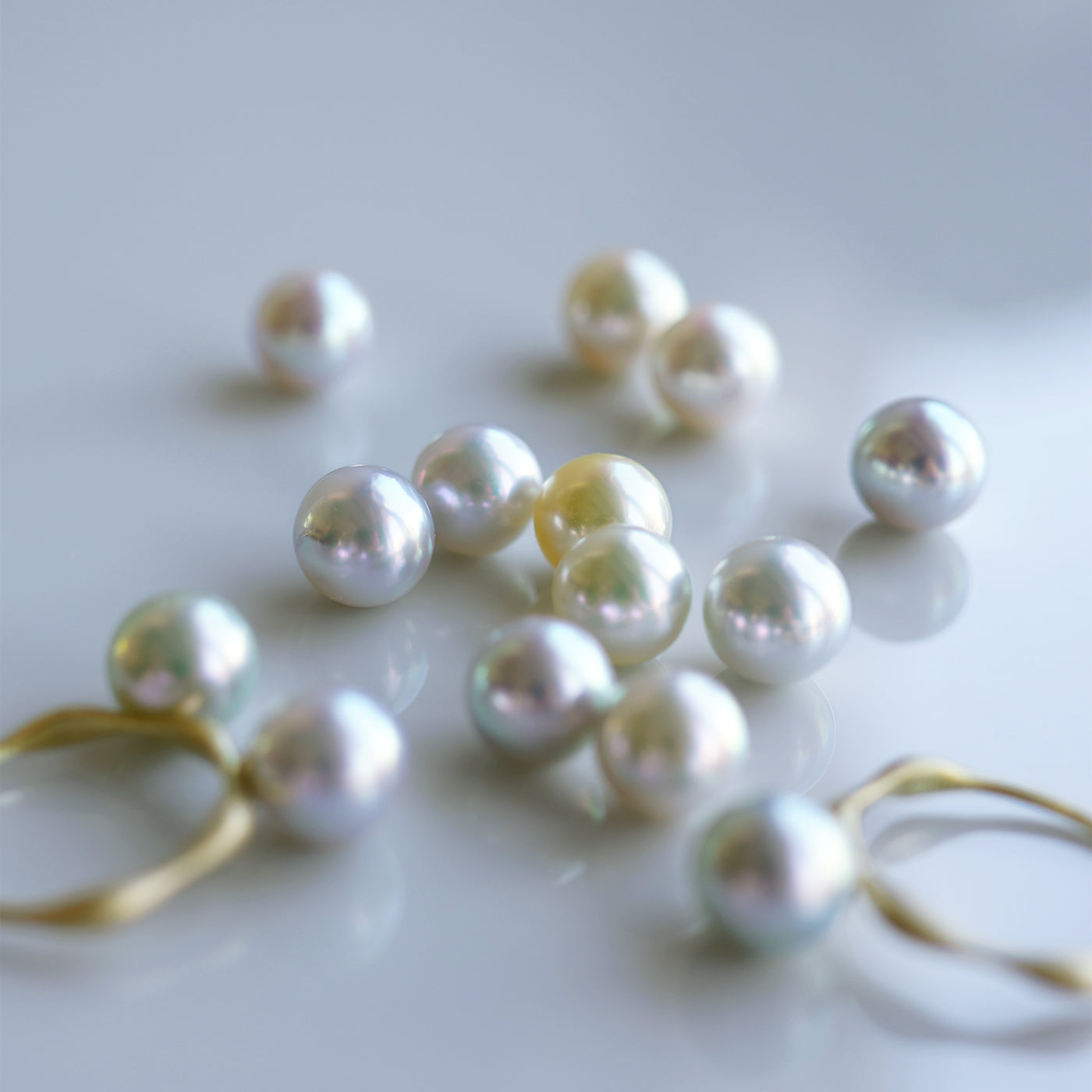
Naturally colored, undyed Akoya pearls with beautiful fancy colors
What is the tinting process for Akoya pearls?
Akoya pearls are strongly associated with a white image, but the majority of raw pearls immediately after being removed from the shell have a yellowish hue, ranging from off-white to cream, and many also show black spots inside.
For this reason, Akoya pearls generally undergo the following processes:
・"Pre-treatment"
A process to enhance the pearl's luster.
・"Bleaching"
A preparatory treatment process that involves drilling a hole about halfway into parts of the pearl with spots or protrusions, and using a specialized solution to remove the yellowish tint and spots from the entire pearl.
・"Tinting process"
During the above process, the inherent reddish hue of the Akoya pearl is lost. Therefore, a small amount of red pigment is added to supplement the color within the nacre layer over time.
This is not a dyeing (coloring) process, but rather a mild process to restore the natural beauty of the material, stabilize its color, and prevent age-related color changes. This is an enhancement treatment, and it does not diminish the value of the pearl.
This process does not diminish the value of the pearl.
Regardless of whether they have undergone tinting, pearls are valued as precious gems. When purchasing, please choose what you like best.
What are undyed Akoya pearls?
"Undyed Akoya pearls" are pearls that have not undergone the "tinting process" after the preliminary treatment.
Undyed Akoya pearls include the following types:
・Those that have only undergone "pre-treatment"
・Those that have undergone "bleaching"
※Those that have undergone "bleaching" are characterized by being mostly white with very little reddish hue.
Those described as "natural color" or "natural color" refer to pearls that have not undergone "bleaching."
About blue and gray Akoya pearls
Pearls accumulate nacre layers during their growth.
At this time, certain organic substances produced by the oyster can enter the nacre layers, resulting in blue or gray hues.
It is rare for organic matter to cover the entire pearl. In most cases, organic matter enters locally, similar to what is seen in spotted raw pearls.
Even pearls that appear entirely blue or gray at first glance often have uneven distribution of organic matter, leading to color variations and spots.
Furthermore, because the entry of organic matter into the layers can cause misalignment in the accumulation of layers, blue and gray Akoya pearls are characterized by their baroque shapes or distorted surfaces.
At sCenes, we handle "undyed" and "natural color" blue and gray Akoya pearls, including "Umigahotaru," which have minimal color variations and spots and beautiful, even coloration.

Raw Akoya pearls


Leave a comments