2023.7.10 | アワビ真珠
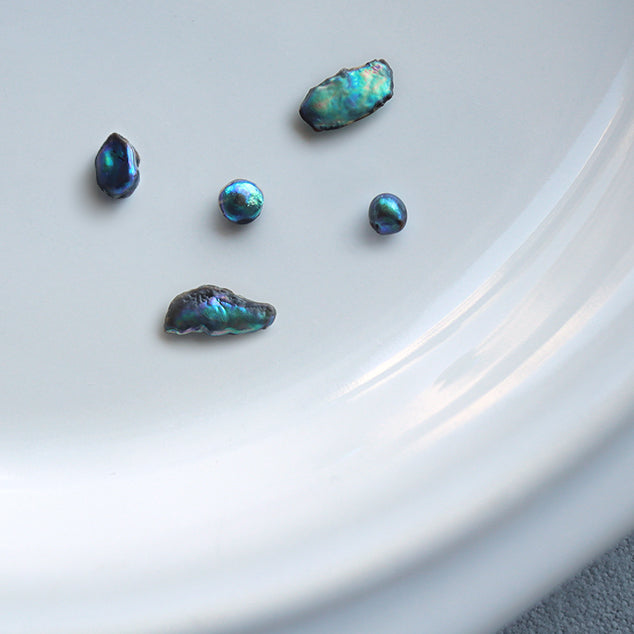
This time, natural abalone pearls that we have newly started handling.
I feel like I'm learning a lot this time.
Of course, it's about abalone pearls, but it might also be because I feel like my values regarding the individuality and beauty of pearls have been updated.
Natural abalone pearls basically almost always have flaws such as black areas where the nacre layer has not formed beautifully.
Because they are natural, their quality is not guaranteed, and considering the characteristics of abalone, which is a gastropod, and the fact that they are formed by chance in nature at a very low probability, it is quite natural for them to have flaws.
In fact, I've come to think that if we consider these flaws as the unique individuality of natural pearls, they aren't necessarily a bad thing.
If we can highlight the beautiful parts while openly showing the flaws, we can enjoy that individuality and it becomes a beloved piece.
From the perspective of rarity, natural and cultured pearls are very different, so the way we think about flaws is completely different. But how can we best present the pearls in the form they emerge from the shell?
I belatedly realized that whether they are natural or cultured, highlighting their inherent individuality and crafting them into jewelry is what's important for someone who handles pearls.
Perhaps I was too focused on slightly higher-grade pearls.
Of course, as a pearl specialist, there are some aspects I can't compromise on, but I want to deliver the charm of pearls from a broader perspective, in a way that is unique to sCenes.


Leave a comments