Why do saltwater and freshwater pearls differ in value?
I will explain the reasons as clearly as possible.
Broadly speaking, the factors that differentiate value are "rarity due to production volume" and "differences in pearl appearance."
What is "Rarity due to Production Volume"?
Three key points contribute to differences in rarity due to production volume:
➀ Differences in Mother Oyster Size
- Saltwater Pearls -
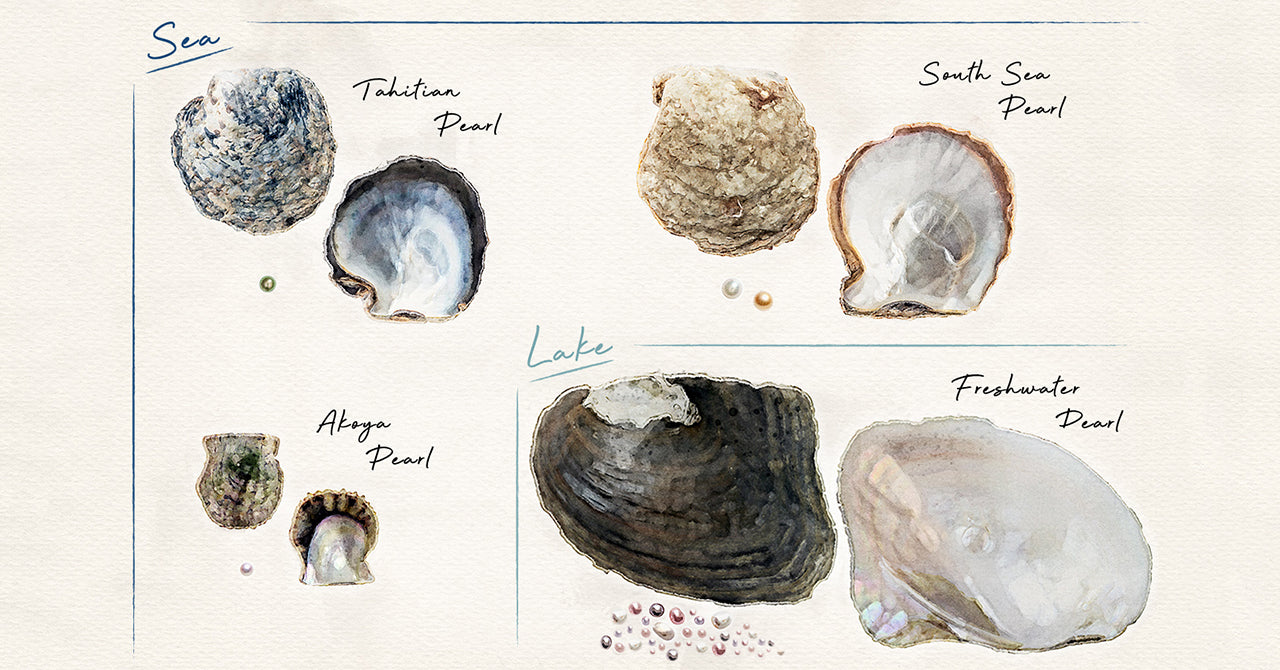
The mother oysters for pearls produced in saltwater, such as Akoya, South Sea, and Tahitian oysters, are small in size. Therefore, the quantity of pearls produced by a single oyster is typically one, or at most a few when producing small-sized pearls.
- Freshwater Pearls -
Ikejyo oysters (a Japanese endemic species, now crossbred with Hyriopsis schlegelii for cultivation in Japan) and Hyriopsis schlegelii (a Chinese endemic species) cultivated in freshwater bodies like lakes are large in size. A single Ikejyo oyster can cultivate up to about 10 pearls, and a Hyriopsis schlegelii oyster can cultivate up to several tens of pearls.
*Refer to the heading image for a rough comparison of shell sizes.
➁ Differences in Procedures Applied to Mother Oysters
- Saltwater Pearls -
A spherical base for cultured pearls called a "nucleus", made from shell, and a piece of mantle tissue called a "piece" are inserted into the mother oyster. Nacre then builds up around these, forming the pearl.
The technique of inserting these two components into the correct location is extremely difficult, and the outcome heavily depends on the skill of the artisan. Furthermore, since they are inserted one by one into each oyster, it is time-consuming.
The farmer's skill is demonstrated in how well they can produce a round pearl with a thick, well-formed nacre layer around the nucleus.
- Freshwater Pearls -
The majority of production is "non-nucleated", with only a "piece" being inserted into the mother oyster.
Because the mother oysters are large, it's possible to insert many pieces into one oyster at once, making the process faster compared to saltwater pearls.
Since there is no nucleus and the nacre layer forms, various shapes of pearls are produced.
While "nucleated" freshwater pearls are improving in quality due to advancements in cultivation technology and are increasing in overall production ratio year by year, non-nucleated freshwater pearls still account for the majority of total production.
➂ Differences in Rearing Environment
- Saltwater Pearls -
Cultivated in the ocean, which has waves and is unstable. This requires considerable effort and cost (such as labor and operating expenses), including moving the oysters during cultivation according to the season and sea conditions, and removing and cleaning barnacles and seaweed attached to the oysters.
- Freshwater Pearls -
Produced in lakes, which are relatively calm environments without waves. Essentially, oysters are kept in the lake and cultivated with regular monitoring of their condition.
It is possible to produce them more efficiently with less effort than in the sea, and operating costs are also lower compared to saltwater cultivation. (Regarding labor costs, the labor costs in China, which accounts for 99% of overall freshwater pearl production, are currently also lower compared to those for saltwater pearl workers in Japan or Tahiti, which is one contributing factor.)
As explained above, the main factor creating the difference in value between saltwater and freshwater pearls is the difference in productivity across these three categories. In terms of annual production, if freshwater pearls are 100, saltwater pearls are less than 5%, thus varying in terms of rarity.
| Akoya Pearl | Tahitian Pearl | South Sea Pearl | Freshwater Pearl | |
|---|---|---|---|---|
| Water Type | Sea | Sea | Sea | Lake |
| Annual Production (kg) | Approx. 22,000 | Approx. 13,000 | Approx. 12,000 | Approx. 1,550,000 |
| Origin | Approx. 90% Japan, 10% Vietnam, China | Approx. 99% Tahiti, less than 1% Fiji, etc. | Approx. 45% Indonesia, 20% Philippines, 20% Australia, 15% Myanmar, etc. | Approx. 99% China, less than 1% USA, Japan, etc. |


