タヒチ黒蝶真珠
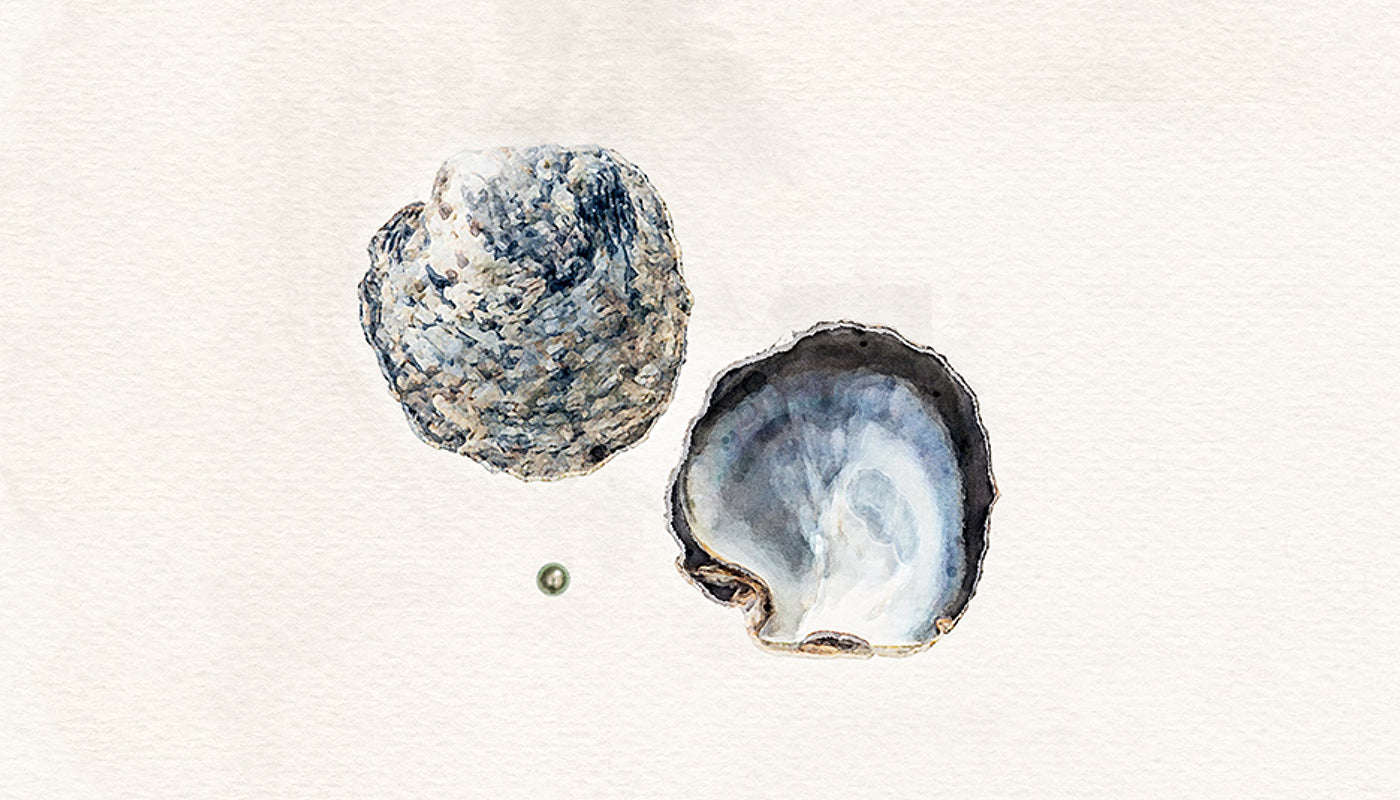
| Black-lipped Pearl | |
|---|---|
| Chemical Name: | Calcium Carbonate |
| Main Components: | Aragonite, Conchiolin |
| Luster: | Pearlescent |
| Hardness: | 2.5-4.5 |
| Refractive Index: | 1.52-1.69 |
| Specific Gravity: | 2.6-2.9 |
Pearls harvested from the black-lipped oyster (scientific name: Pinctada margaritifera), cultivated in the South Pacific waters of Tahiti and other regions.
They are also known as Tahitian pearls.
Black-lipped oysters produce proteins that contain the primary colors red, blue, and yellow, resulting in more complex colorations compared to other pearls. They produce a wide variety of colors, from black to green, blue, red, and silver.
Black-lipped oysters are smaller than white-lipped oysters but larger than Akoya oysters, with common sizes ranging from 8mm to 16mm.
Particularly large sizes are mostly light in color, while darkly colored ones are rare and highly valuable.

What is Rikitea Black-lipped Pearl?
The main production area for black-lipped pearls is Tahiti (officially known as French Polynesia), consisting of 118 islands located in the middle of the Polynesian Triangle, which connects Hawaii to the north, Easter Island to the southeast, and New Zealand to the southwest. Tahiti accounts for approximately 95% of the total production.
Among these, black-lipped pearls produced in several farms in the village of Rikitea on Mangareva Island, located about 1,600 km southeast of Tahiti Island, are traded at high prices in auctions and elsewhere.
The reason for this is that Rikitea black-lipped pearls, originating from the cooler waters of the southeastern region of Tahiti, allow the oysters to slowly form nacre, resulting in pearls with fine texture and beautiful luster, making them of particularly high quality compared to those from other areas.
Another significant factor is that Mangareva Island, where Rikitea village is located, has abundant mountains, and mineral-rich water flows from the mountains, which is essential for the growth of the mother-of-pearl oysters.


Leave a comments