2024.12.04 | New Jewelry TOKYO 2024
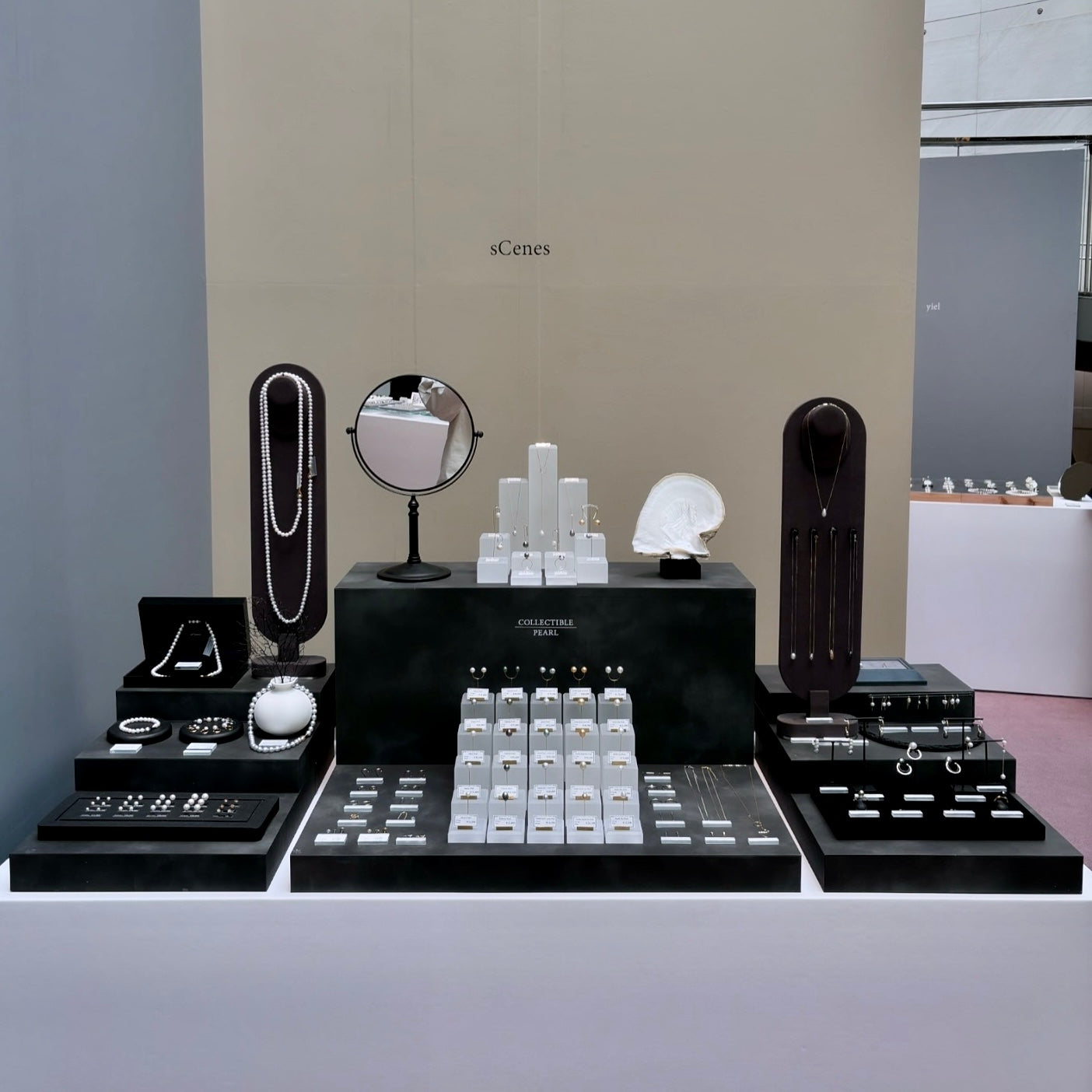
<New Jewelry TOKYO 2024>, which was held over three days,
has successfully concluded.
This was our second time participating, and I am sincerely grateful for all the new customers we met.
Since the thank-you message up to this point is the same as on Instagram, I'll change things up a bit for the blog (apologies for the lack of updates).
If you look at last year's post after the event, it's immediately clear that my display was cluttered, and I remember being shocked by how refined the displays of the surrounding brands were.
For COLLECTIBLE PEARL, I wanted customers to enjoy choosing their favorite pearls, so I planned the booth with the idea of lining up cases of loose pearls and chatting with customers. However, this ended up taking up most of the limited space, making it impossible to create a clean look, and it became cluttered. I was quite disappointed with myself.
After that, an event at Isetan, where displaying loose pearl cases was prohibited, became a turning point. I started experimenting with how to convey the joy of COLLECTIBLE PEARL, how to create as much empty space as possible, and paying attention to the viewer's perspective. Through several experiences, the display gradually evolved into the form it took at this NJT.
Looking at the photos this time, I feel like I've made some progress compared to last year, but I'm still not satisfied—my usual negative thinking. I hope to continue growing and enjoying the display process until it feels truly like sCenes.
Next, we plan to hold an event at Hankyu Umeda Main Store on the 1st floor from December 18th (Wednesday).
To everyone in Kansai, if you have time, please stop by☺︎
2024.09.03 | About Akoya Pearls Color
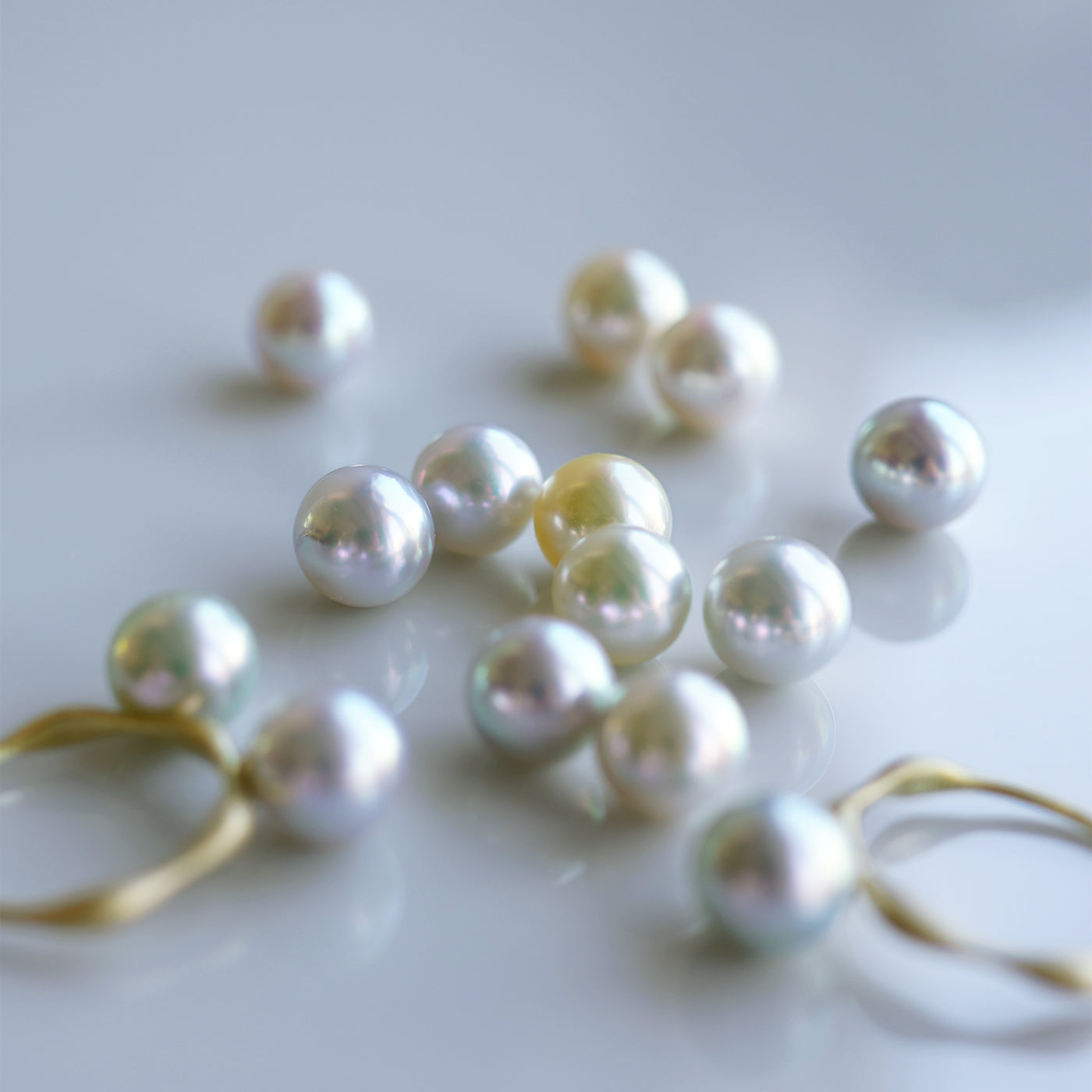
Naturally colored, undyed Akoya pearls with beautiful fancy colors
What is the tinting process for Akoya pearls?
Akoya pearls are strongly associated with a white image, but the majority of raw pearls immediately after being removed from the shell have a yellowish hue, ranging from off-white to cream, and many also show black spots inside.
For this reason, Akoya pearls generally undergo the following processes:
・"Pre-treatment"
A process to enhance the pearl's luster.
・"Bleaching"
A preparatory treatment process that involves drilling a hole about halfway into parts of the pearl with spots or protrusions, and using a specialized solution to remove the yellowish tint and spots from the entire pearl.
・"Tinting process"
During the above process, the inherent reddish hue of the Akoya pearl is lost. Therefore, a small amount of red pigment is added to supplement the color within the nacre layer over time.
This is not a dyeing (coloring) process, but rather a mild process to restore the natural beauty of the material, stabilize its color, and prevent age-related color changes. This is an enhancement treatment, and it does not diminish the value of the pearl.
This process does not diminish the value of the pearl.
Regardless of whether they have undergone tinting, pearls are valued as precious gems. When purchasing, please choose what you like best.
What are undyed Akoya pearls?
"Undyed Akoya pearls" are pearls that have not undergone the "tinting process" after the preliminary treatment.
Undyed Akoya pearls include the following types:
・Those that have only undergone "pre-treatment"
・Those that have undergone "bleaching"
※Those that have undergone "bleaching" are characterized by being mostly white with very little reddish hue.
Those described as "natural color" or "natural color" refer to pearls that have not undergone "bleaching."
About blue and gray Akoya pearls
Pearls accumulate nacre layers during their growth.
At this time, certain organic substances produced by the oyster can enter the nacre layers, resulting in blue or gray hues.
It is rare for organic matter to cover the entire pearl. In most cases, organic matter enters locally, similar to what is seen in spotted raw pearls.
Even pearls that appear entirely blue or gray at first glance often have uneven distribution of organic matter, leading to color variations and spots.
Furthermore, because the entry of organic matter into the layers can cause misalignment in the accumulation of layers, blue and gray Akoya pearls are characterized by their baroque shapes or distorted surfaces.
At sCenes, we handle "undyed" and "natural color" blue and gray Akoya pearls, including "Umigahotaru," which have minimal color variations and spots and beautiful, even coloration.

Raw Akoya pearls
2023.12.14 | New Jewelry TOKYO 2023
It's been a while since my last post again.
Before I knew it, it's already pre-Christmas, the year-end party season of December.
It feels like time passes faster each year.
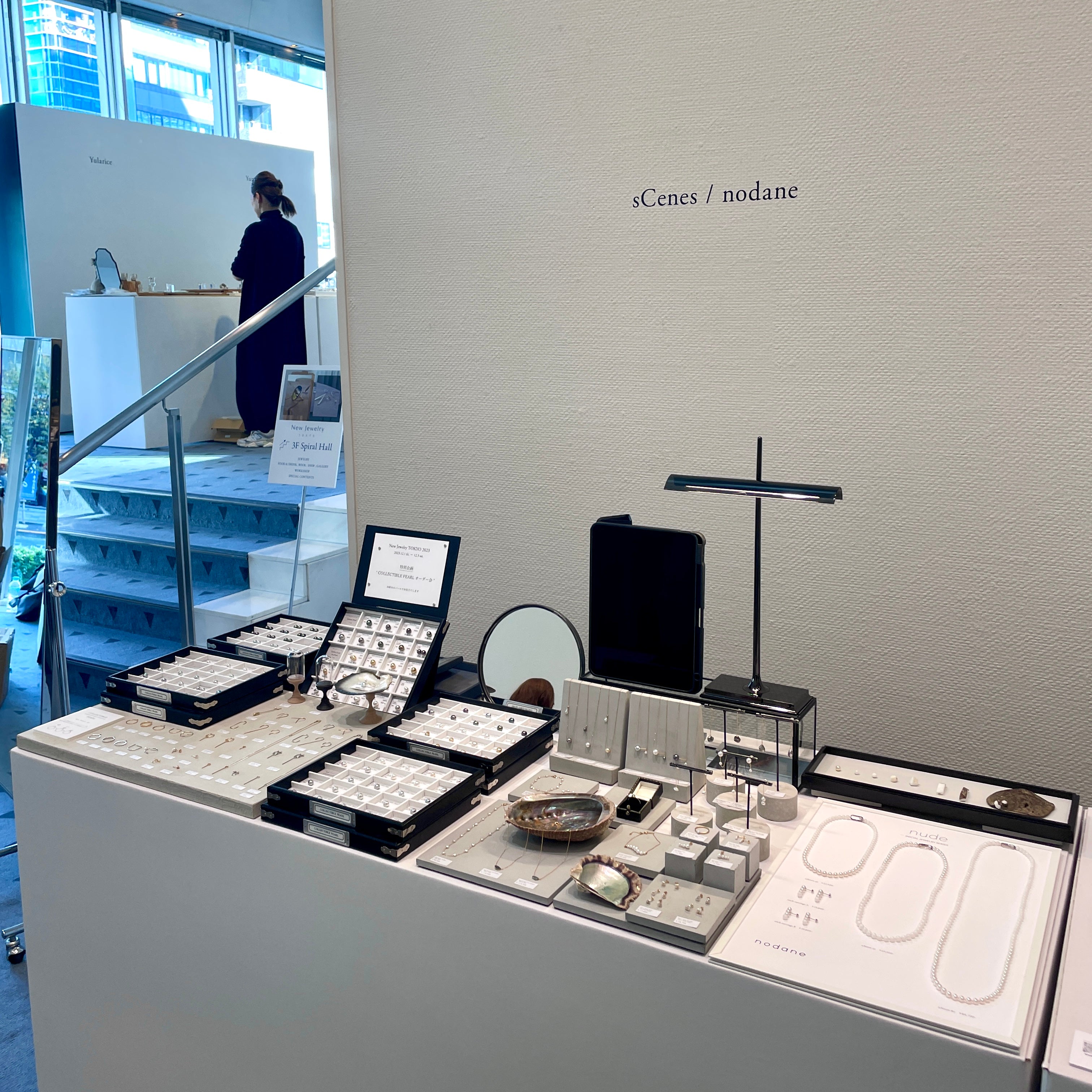
This December brought significant changes for sCenes, as we had the opportunity to exhibit at "New Jewelry TOKYO 2023" held at SPIRAL in Tokyo.
It was our first event in Tokyo since the order fair we held in a rented space in Daikanyama, and I was so happy to meet many customers.
That moment of customers directly choosing their pearls is truly special, and it's fascinating how everyone's preference for pearls differs, which makes me even more passionate when explaining them.
It was much busier than I expected, and the three days flew by so quickly that I even forgot about my hernia, making it a fun and memorable event.
However, compared to other exhibitors, there are still many areas where we need to improve, and I realized that we must use this reflection to become more refined.
Truly, continuous improvement every day.


